"Born in Toronto to an Affluent Family" Helen McNicoll: Rediscovering a Trailblazer in Canadian Art
Helen Galloway McNicoll: Rediscovering a Trailblazer in Canadian Art

Portrait of Helen McNicoll painted by Robert Harris, c 1910
When thinking of women artists throughout history, a few very popular, somewhat routine names may come up. Think Frida Kahlo and Georgia O'Keeffe. These two icons have become synonymous with boldness, strength, and individuality. In Canada, however, one name is always the first to bubble up on the tongue—Emily Carr. Now, don't get me wrong, I was born and raised in Victoria, British Columbia, Emily's birthplace, home, and ultimately, where she was laid to rest in a very simple family plot of the Ross Bay Cemetery. I love her work as much as anyone in Victoria, and though my interest in her has always been focused more on her Impressionist works from her time in France and England during 1910, she will always be recognisable to myself and others for her nature scenes done during her time amongst the First Nations in and around Victoria’s surrounding islands.
But as the years have gone on, I have spent more time looking into other trailblazing Canadian women artists who, in their own right, deserve to be far more famous than the Group of Seven. Sorry, Ontario. One such artist is Helen Galloway McNicoll, (shown in the portrait above, painted by Robert Harris from the Group of Seven) whose impact on Canadian art is profound, yet still not as widely known as it should be.

Under the Shadow of the Tent by Helen McNicoll, c.1913
A Life of Promise: Early Years and Education
Born December 14, 1879, in Toronto to British immigrants, Helen Galloway McNicoll came from a close-knit family of seven children. Her father worked in the railroad industry, granting her access to the industrial elite of the time and offering opportunities for travel—experiences that would greatly shape her artistic vision. With the financial backing and support from her family, McNicoll pursued her passion for art.
In 1902, McNicoll moved to London to study at the prestigious Slade School of Fine Art. It was here that she met Dorothea Sharp, an artist who would become her lifelong partner, both in painting and in life. Encouraged by their professors to paint en plein air (outdoors, directly from nature), McNicoll and Sharp moved to Cornwall to study at St. Ives, a location known for its vibrant artistic community. It was during this period that McNicoll refined her Impressionist style, learning to capture light in all its nuanced forms—a skill that would define her later works.
Her artistic journey continued in Canada though, where she joined the Art Association of Montreal (AAM) in 1906. The AAM was ahead of its time in offering progressive education for women, including the controversial opportunity to study the nude figure—something that many traditional art schools at the time forbade. This exposure to more advanced techniques helped McNicoll develop her signature style, marked by her ability to render both light and shadow with an almost poetic quality.
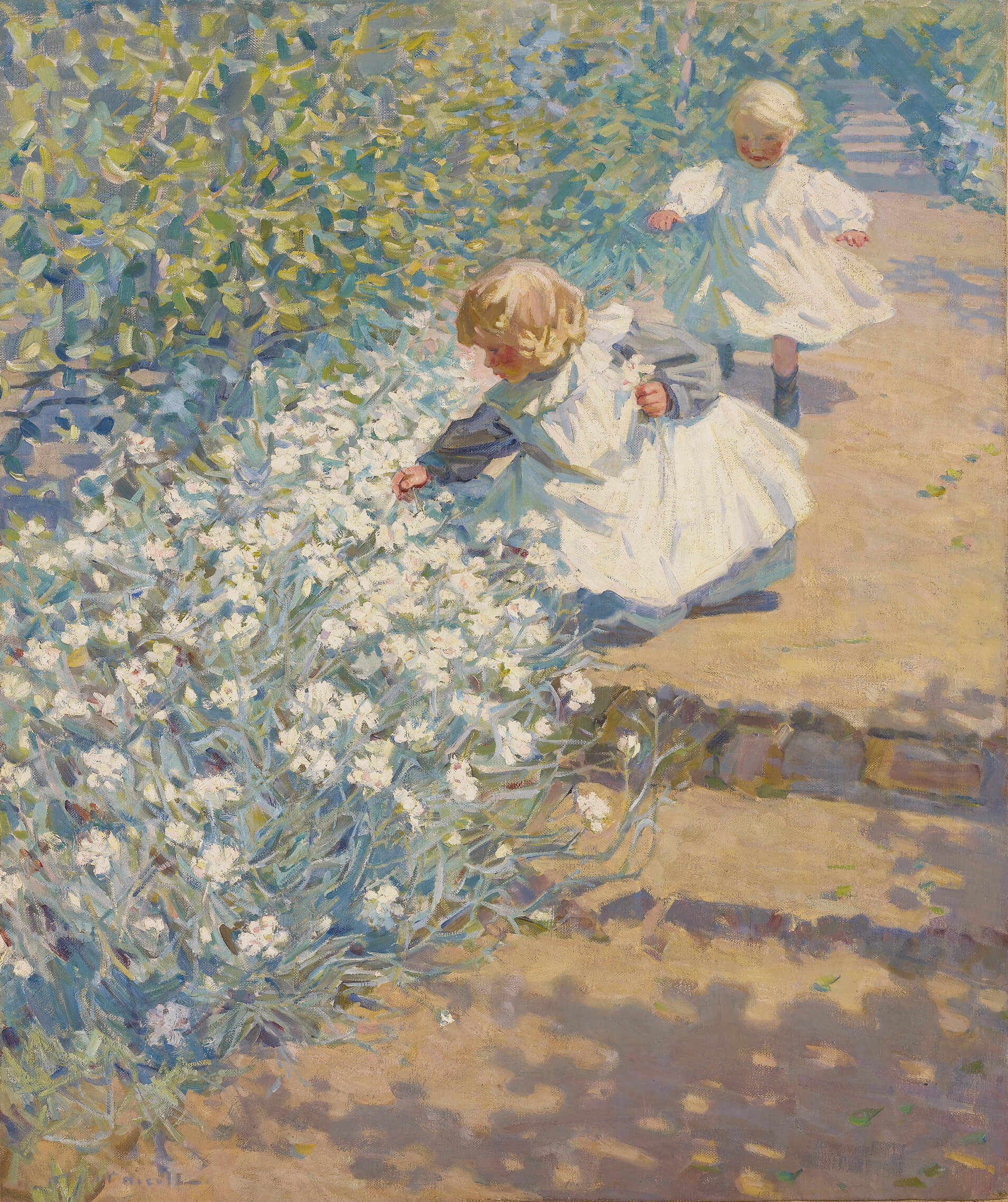
Picking Flowers by Helen McNicoll, c. 1914
A Master of Impressionism: Painting the Quiet Beauty of Everyday Life
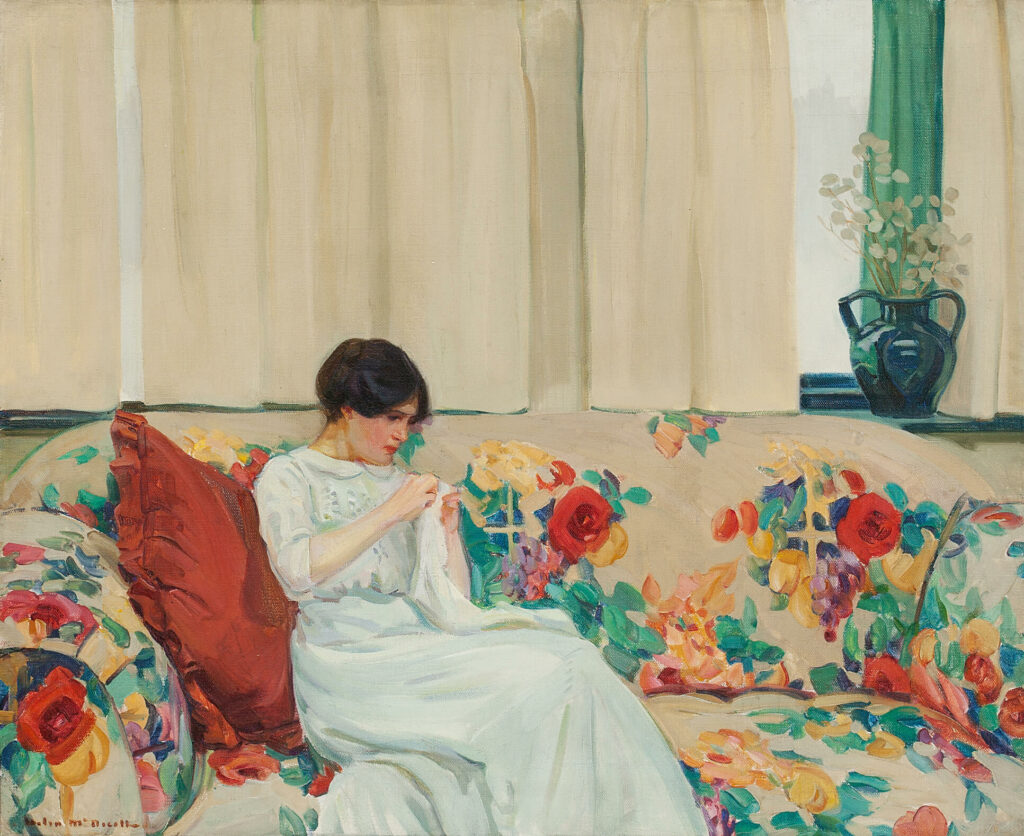
McNicoll's works stand out for their soft, evocative depictions of domestic life, children, and the natural world. Her use of light, especially in shadowy scenes, demonstrate her mastery of the Impressionist style. Many of her paintings feature women and children in rural or garden settings, illustrating the beauty in the quiet moments of everyday life. One of her most famous works, Picking Flowers, 1914, epitomises her ability to capture light and shadow, bringing an almost ethereal quality to her subjects.
Though McNicoll was part of a generation of women artists whose subject matter often focused on domesticity—such as the family, children, and nature—her work offers much more than the typical female art of her time. Her pieces exude a subtle yet powerful sense of intimacy and connection, as though inviting the viewer into her private world. The bold use of color, particularly in her landscapes, has led many art critics to compare her to artists like Mary Cassatt, another Impressionist who also focused on domestic scenes and women’s lives.
I was lucky enough to attend the Cassatt-McNicoll: Impressionists Between Worlds exhibition at Toronto's Art Gallery of Ontario (AGO) May 31, 2023 - September 4, 2023. The parallels drawn between the two artists were profound, though it was unfortunate that the knowledge surrounding McNicoll’s life and work is still far inferior to that of Mary Cassatt. I wonder, had McNicoll lived longer, if she too would have been remembered as one of the greats of Impressionism.

In The Shadow of the Tree by Helen McNicoll, c.1914
Triumphs and Tribulations: The Challenges of Being a Deaf Artist
Despite her many accomplishments, McNicoll faced considerable challenges in both her personal and professional life. At the age of two, she contracted scarlet fever, which resulted in severe hearing loss. This setback did not deter her; in fact, it likely influenced her ability to concentrate deeply on the visual aspects of her art. Lip reading and assistance from her friends—especially Dorothea—enabled her to navigate the art world. But even in the face of such adversity, McNicoll’s determination and passion for her craft never wavered.
She continued to exhibit her work in both Canada and Britain, and by 1913, she was elected to the Royal Society of British Artists. In 1914, she became an Associate of The Royal Canadian Academy of Arts. Despite these achievements, McNicoll’s life was tragically short. She died of complications from diabetes in 1915 at the age of just 35, leaving behind a body of work that would continue to be praised well into the 1920s.
A Legacy Cut Short: Why Don’t We Know Her?
Despite her immense talent, McNicoll's name has never gained the level of recognition it truly deserves. Over the years, she contributed more than seventy works to exhibitions in both Canada and Britain, and her art was widely praised. Her mastery of Impressionism, along with her poignant, intimate depictions of women, children, and the landscapes around her, remain important contributions to the canon of Canadian art.
Her impact was recognized during her lifetime—she was lauded as "one of the most profoundly original and technically accomplished of Canadian artists." And yet, in the decades that followed, her name seemed to fade into the background of Canadian art history. Perhaps it is due to the fact that she lived outside of the major art centers of Toronto and Montreal, or maybe it’s because she was overshadowed by other artists like Emily Carr or the Group of Seven, whose names have become synonymous with Canadian art. Whatever the reason, McNicoll’s work deserves to be remembered, and her achievements acknowledged alongside the greats of both Canadian and international art.
Rediscovering Helen Galloway McNicoll
The quiet brilliance of Helen Galloway McNicoll is often overlooked in favor of more well-known names in the art world, but her contributions are undeniably significant. Through her work, McNicoll demonstrated an uncanny ability to render light, color, and the beauty of everyday life. She was a pioneering woman in the art world, a deaf artist who overcame the odds to leave an indelible mark on Canadian art history.
If she had lived longer, there’s little doubt that McNicoll’s name would be more widely recognized today. But as we rediscover her works—through exhibitions like Cassatt-McNicoll: Impressionists Between Worlds—it’s clear that her legacy is one that continues to inspire. Her quiet, yet bold, vision still speaks to us, reminding us of the power of light, color, and the beauty found in the simplest moments of life.
Helen Galloway McNicoll’s art might not be as widely known as Emily Carr’s, but it’s about time it was. Let’s ensure that her contribution to the Canadian art scene—and to the Impressionist movement—is celebrated for generations to come.


Comments
Post a Comment