Smuggling Genius: Peggy Guggenheim, Degenerate Art, and the Women the Nazi's Tried to Erase
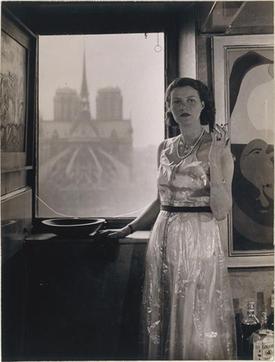
Guggenheim in Paris c. 1930. Background: view of Notre-Dame de Paris, painting Dutch Interior II, by Joan Miró (1928) photograph by Rogi André
During one of the darkest chapters of the 20th century, when creativity was criminalised and dissent painted over with fear, an American heiress named Peggy Guggenheim quietly orchestrated one of the most daring cultural rescues in history. Her mission: to save modern art — the so-called "degenerate" works that the Nazis condemned, looted, and tried to erase — including works by women artists whose voices were doubly silenced by politics and patriarchy.
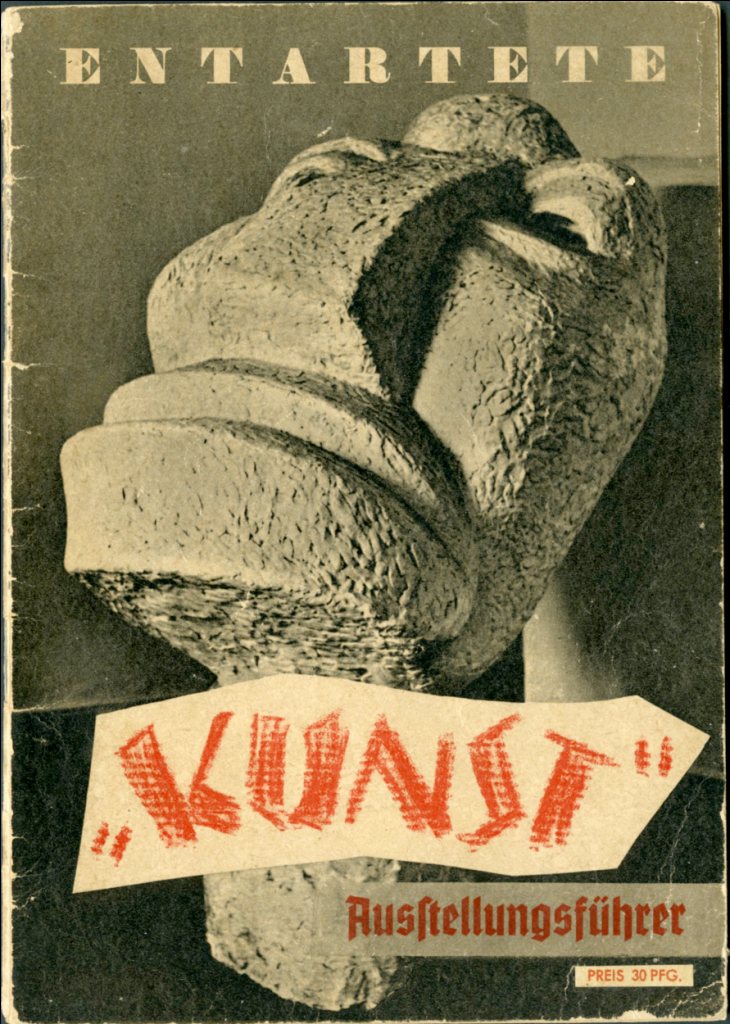
The Nazi War on Modern Art
When Adolf Hitler rose to power in 1933, his regime launched a war not just on people, but on ideas — especially the bold, abstract, and experimental art movements that had defined early 20th-century Europe. Modernism, in all its forms, was labeled Entartete Kunst ("degenerate art"). Expressionism, Cubism, Surrealism, Dada, and anything that deviated from rigid Nazi ideals of Aryan beauty were banned, removed from museums, or publicly ridiculed.
In 1937, the Nazis mounted the infamous Degenerate Art Exhibition in Munich, showcasing over 650 confiscated works by artists such as Paul Klee, Marc Chagall, Wassily Kandinsky, and Ernst Ludwig Kirchner — not to honor them, but to mock and shame them. The show drew millions of visitors, serving as propaganda to equate modernism with moral and racial decay. Meanwhile, another exhibition next door glorified "approved" art: heroic Aryan nudes, pastoral scenes, and military triumphs.
But as the Nazis condemned this "degenerate" art, they also exploited it. Some pieces were burned or destroyed, but many were hoarded, traded, or sold — especially works by now-famous names like Picasso and Matisse, whose market value remained high abroad. The Nazi looting machine became one of the largest art thefts in history, targeting Jewish collectors, galleries, and museums across occupied Europe.
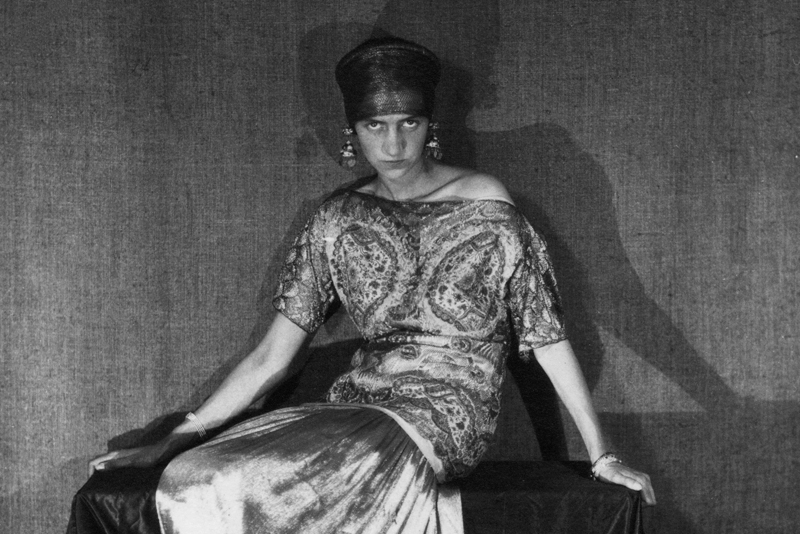
Peggy Guggenheim in a dress by Paul Poiret and a headdress by Vera Stravinsky, photographed by Man Ray, Paris, c.1925
Peggy Guggenheim: Heiress, Rebel, Rescuer
Into this atmosphere of cultural persecution stepped Peggy Guggenheim — wealthy, eccentric, and passionately devoted to modern art. The niece of mining tycoon Solomon R. Guggenheim, Peggy had the means, but also the vision, to see that art needed to be not just admired, but protected.
Living in Paris in the 1930s, Guggenheim had already become a patron and collector, mingling with avant-garde artists and writers like Samuel Beckett, Man Ray, and Marcel Duchamp. As fascism spread, she began a race against time — and against Hitler — to assemble and save a collection of modernist art before it could be destroyed or lost.
In 1939, just as war was breaking out, she set herself a remarkable goal: to buy one painting a day.
Working with dealers like Jean Bucher and curators like Herbert Read, Guggenheim acquired works by Picasso, Miró, Max Ernst, and others at a breakneck pace. Some of these works had been seized or were being sold under duress by artists fleeing persecution. She stored them in crates, sometimes hidden in plain sight, even as the Gestapo tightened its grip on Paris.
Eventually, she smuggled the art out of Nazi-occupied France — crated as "household goods" — and fled to New York in 1941, bringing with her an irreplaceable cache of what the Nazis had tried to erase.
Women Artists in the Crosshairs
While the Nazi regime broadly targeted modernism, women artists suffered uniquely under both fascist ideology and systemic sexism. The few women who had gained recognition in the male-dominated art world found themselves doubly vulnerable — as artists of the "wrong" style and the "wrong" gender.
Take Käthe Kollwitz, a German printmaker and sculptor whose haunting depictions of war, grief, and social struggle ran counter to Nazi ideals of strength and conformity. Though she had once been the first woman elected to the Prussian Academy of Arts, she was forced to resign in 1933. Her work was removed from public view.
Hannah Höch, a pioneer of Dada and photomontage, saw her work ridiculed as degenerate, not just for its style but for its feminist critique of German society. Höch had to work in secret, isolated in Berlin during the war years, her groundbreaking visual language nearly lost to history.
Sophie Taeuber-Arp, a Swiss-born painter, sculptor, and dancer, was married to Jean Arp and heavily involved in the Dada and Constructivist movements. Though not directly persecuted by the Nazis due to her Swiss citizenship, her work was marginalized in the male-dominated narrative of modernism — and largely ignored during the era of Nazi censorship.
Guggenheim’s collection — and her broader support for women artists — helped ensure that some of these voices were not completely erased. Though she herself did not always center women in her collecting, she later recognized the imbalance and worked to promote overlooked female artists. Her support for Leonora Carrington, Dorothea Tanning, and Lee Krasner, among others, helped challenge the male-centric art canon.
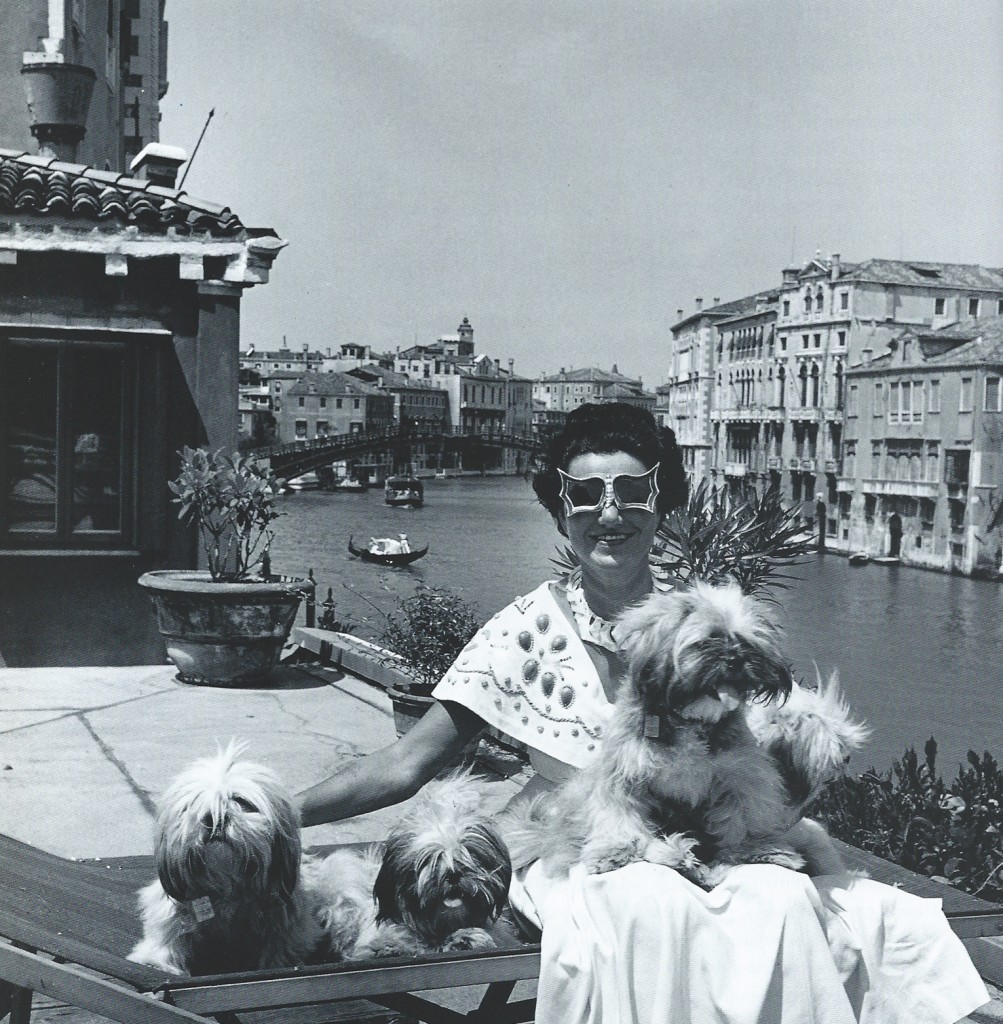
Peggy Guggenheim on the roof of Palazzo Venier with her beloved Lhasa apso dogs
A Legacy of Defiance
Today, the Peggy Guggenheim Collection in Venice stands as one of the most important collections of modern art in the world. But behind its white walls and serene canals lies a story of resistance and risk — of smuggling culture out of the clutches of tyranny and into the light of the future.
Guggenheim may have been eccentric, impulsive, and sometimes controversial, but in the face of totalitarianism, she chose to act. She preserved not just paintings and sculptures, but entire chapters of human expression that might otherwise have vanished.
And among those saved were not only Picasso and Ernst, but the obscured, persecuted, and often forgotten women who dared to create in defiance of dogma. The Nazis tried to silence them — Peggy Guggenheim helped ensure the world would remember them instead.
Further Reading:
The Rape of Europa by Lynn H. Nicholas
Peggy Guggenheim: The Shock of the Modern by Francine Prose
Women Artists and the Surrealist Movement by Whitney Chadwick
The Art of Suppression: Confronting the Nazi Past in Histories of the Visual and Performing Arts by Pamela M. Potter
Art endures. Tyranny does not.


Comments
Post a Comment