The Fatal Fates of Femme Fatales
Into the Shadows: The Femme Fatale in Art History
Across centuries of art, few archetypes have captivated—and unsettled—the human imagination quite like the femme fatale. She is the woman who lures, seduces, ensnares; the figure whose beauty is entwined with danger, whose power often emerges from the anxieties, fantasies, and fears projected onto her by patriarchal cultures.
In art history, the femme fatale becomes a mirror—reflecting not only myths of destructive femininity, but also deeper cultural tensions around autonomy, sexuality, and female agency.
In this post, we’ll journey through the rich and often contradictory representations of the femme fatale in Western art, tracing how artists shaped these iconic women into symbols of temptation, ruin, or forbidden knowledge. From ancient mythology to nineteenth-century decadence, the femme fatale shifts form, but her magnetic pull remains constant.
In the post ahead, we’ll explore four of art history’s most fascinating and enduring femmes fatales:
Medusa- the monstrous beauty whose gaze petrifies
Lilith- the rebellious first woman recast as a demon of seduction
Calypso- the enchantress who delays a hero’s journey with her irresistible charm, and
Salome- the biblical dancer whose desire and defiance sparked centuries of scandalous imagery.
Together, these figures reveal far more than stories of danger and desire—they expose the mechanics of myth-making itself, and the enduring cultural impulse to both fear and fetishise powerful women. Let’s step into the shadows and see what they have to say.
*Before we get started just a quick note, this is my longest blog post yet...and for good reason. It's filled with rich, fascinating information about several powerful women who truly deserve their moment in the spotlight. I encourage you to take it in at your own pace, in digestible chunks, and enjoy the journey through their stories. There's a lot to explore, and each woman's impact is worth every minute of your time, and attention. I hope you enjoy reading it as much as I enjoyed writing it.*

Medusa: The Eternal Femme Fatale in Art History
Few mythological figures have haunted the imagination of artists quite like Medusa, the Gorgon whose beauty was both her power and her curse. From the classical world to the present day, she has been painted, sculpted, and reimagined not just as a monster, but as the archetype of the femme fatale — the dangerously alluring woman who embodies both desire and destruction.
From Victim to Seductress: The Myth Reinterpreted
In Greek mythology, Medusa was once a beautiful mortal priestess of Athena who was violated by Poseidon within the goddess’s temple. Athena’s punishment — transforming Medusa’s flowing hair into serpents and her gaze into stone — marks one of the earliest artistic and literary instances of victim-blaming. Yet in later interpretations, especially during the Renaissance, Medusa’s tragedy was obscured by her terror. Artists like Caravaggio, above, and Leonardo da Vinci (both versions of his works now lost) emphasised her power to petrify, turning her image into a warning about the dangers of feminine allure and independence.
The Gaze and the Male Fear of Female Power

The male gaze dominates most early depictions of Medusa. The artists’ fascination with her severed head — seen in Caravaggio’s Medusa (1597) or Benvenuto Cellini’s Perseus with the Head of Medusa (1545–1554) above — reflects a cultural desire to control the uncontrollable: the female gaze itself. Medusa’s power to “see” and to render men motionless is a metaphor for female autonomy, reinterpreted by patriarchal society as monstrous. Her decapitation becomes a symbolic act of silencing women’s power, beauty, and rage.

By the 19th and 20th centuries, artists and writers began to reinterpret Medusa as a figure of female resistance rather than seduction. Symbolist painters like Franz von Stuck (above) and Arnold Böcklin lingered on her melancholy rather than her menace, while artists of the 20th/21st centuries — such as Luciano Garbati, whose 2008 sculpture Medusa with the Head of Perseus (seen below) reverses the myth — have reclaimed her image as one of justice and empowerment.

Medusa Reconsidered
Medusa’s evolution from monster to muse reveals the deep entanglement between fear and fascination with female sexuality in Western art. The femme fatale is never merely a seductress — she is the embodiment of cultural anxiety about women who see too much, know too much, or cannot be controlled. In reclaiming Medusa, contemporary art reclaims not only her gaze, but the right of women to wield it unapologetically.

Lilith: The Original Femme Fatale in Art History
Before Eve, there was Lilith — a figure whispered about in myth, feared in religion, and immortalised in art. Long before she became a symbol of rebellion and sensual power, Lilith was cast out of Eden for refusing to submit. Her story, born from Jewish mysticism and later reimagined through centuries of Western art, positions her as the archetypal femme fatale — the woman who chooses independence over obedience, desire over duty.
Origins of the Myth: From Demon to Symbol of Defiance
Lilith’s roots trace back to Mesopotamian mythology, where she appeared as a wind spirit or night demon. In later Jewish folklore, she emerges as Adam’s first wife, created from the same clay as he. Unlike Eve (born of Adam's rib), Lilith (made from the same clay as Adam) refused to be subservient — a choice that saw her demonised, exiled, and rewritten as the destroyer of men and infants. Her transformation from equal partner to dangerous temptress reveals more about societal fears of women’s autonomy than about any true wickedness.
The Romantic and Pre-Raphaelite Lilith: Beauty as Danger

The 19th century saw Lilith revived in art and poetry as an emblem of erotic danger. The Pre-Raphaelites, with their fascination for mythic femininity, reimagined her as a fatal beauty. In Dante Gabriel Rossetti’s Lady Lilith (1866–1868), she is a luminous, narcissistic woman combing her cascading hair — a sensual, modern Eve whose self-absorption is coded as sin. Her languid pose, surrounded by flowers, mirrors the Victorian unease with female sexuality and self-possession.

Similarly, John Collier’s Lilith (1887) presents her nude, entwined with a serpent, her gaze calm and knowing. The serpent — a traditional symbol of temptation which we will theorise further in this post— here becomes an extension of her power. These images capture not evil, but an unsettling self-awareness; Lilith’s sexuality is not for the male viewer’s consumption, but for herself.
The Femme Fatale and the Male Gaze
Lilith’s repeated portrayal as a seductress exposes the tension between fascination and fear that defines the femme fatale. In art history, the femme fatale is not simply a dangerous woman — she is a mirror for patriarchal anxieties. To paint Lilith is to paint desire that cannot be possessed. She embodies the threat of female autonomy, intelligence, and refusal — traits that, throughout history, have been transfigured into monstrosity.


Modern Reinterpretations: From Sin to Empowerment
Contemporary artists have reclaimed Lilith as a feminist icon, transforming her from a demon into a heroine of self-determination. In modern photography, digital art, and sculpture, Lilith’s serpentine imagery often becomes a metaphor for rebirth, knowledge, and resistance. Artists such as Kiki Smith have explored her as a complex, multifaceted woman — both shadow and light — challenging the binaries of good and evil, purity and sin.
Lilith’s Lasting Power
Across centuries, Lilith’s image has shifted from demonic to divine, from object of fear to figure of empowerment. As the original femme fatale, she embodies not the danger of female sexuality, but the danger of women who refuse to be tamed. Her legacy in art history reveals how every brushstroke of condemnation can, in time, become a portrait of liberation.

A Hidden Lilith?
If you look closely at Michelangelo’s The Fall and Expulsion from Paradise (1512) in the Sistine Chapel ceiling, you’ll notice something curious—something that feels almost like a secret hidden in plain sight. Twisting around the Tree of Knowledge is not the typical serpent we expect from Genesis, but a woman from the waist up, her long hair flowing, her expression eerily calm as she leans toward Eve. For centuries, viewers have wondered: did Michelangelo mean for this figure to be Lilith, the mythical first wife of Adam, the woman said to have refused submission and fled the Garden long before Eve appeared?
The fresco never answers us outright, and Michelangelo left no notes to guide us, which makes the moment feel even more mysterious. Was he quietly acknowledging the apocryphal stories whispered through medieval lore—tales of a woman associated with independence, seduction, and danger? Or was he simply drawing on the visual tradition of female serpents common in earlier Christian art? The ambiguity opens a narrative door: we find ourselves standing in the garden, wondering whether this hybrid figure represents a forgotten chapter of creation or an artist playing with the boundaries between myth and scripture. Michelangelo gives us just enough to recognise her, but never enough to be certain, leaving the story suspended between what we see and what we imagine.
If this is Lilith, why would he insert such a charged, transgressive figure into one of Christianity’s most foundational narratives? Was he subtly acknowledging alternative creation stories circulating in Renaissance intellectual circles, or was he exploring anxieties about female agency and temptation that were deeply embedded in the culture of his time? The image hovers between myth and theology, truth and possibility, leaving us to wonder whether Michelangelo meant to challenge viewers with a more complex understanding of the Fall—or whether later interpreters have projected Lilith onto the scene because we’re eager to find her wherever a powerful female form appears.
*Mid-Post Check-In: You've made it to the halfway point-nice work! There's a lot of depth and power in these stories, so take a moment to breathe, stretch, or grab a refill of whatever you're sipping or snacking on. When you're ready, dive back in and enjoy the rest of these incredible women's journeys. They have so much to offer, and I am grateful you're taking the time to get to know them.*

Calypso: The Enchantress as Femme Fatale in Art History
In the long lineage of mythic women who both captivate and confound, Calypso occupies a uniquely bittersweet place. Known from Homer’s Odyssey as the nymph who detains Odysseus on her island for seven years, Calypso embodies the allure of eternal pleasure — and the peril of forgetting one’s duty. Artists across centuries have returned to her image, drawn to the tension between seduction and solitude, between divine love and human entrapment. In this way, Calypso emerges as a distinctly femme fatale figure: the woman whose affection holds both desire and danger.
The Classical Foundation: Desire and Delay

In Homer’s epic, Calypso lives on the island of Ogygia, where she rescues the shipwrecked Odysseus and falls in love with him. Her offer of immortality and comfort — rejected by the restless hero — has been interpreted as a test of masculine virtue. Yet within art and literature, Calypso’s “fatal” quality is not her malice, but her power to captivate. Her island becomes a metaphorical snare, a paradise that doubles as a prison.

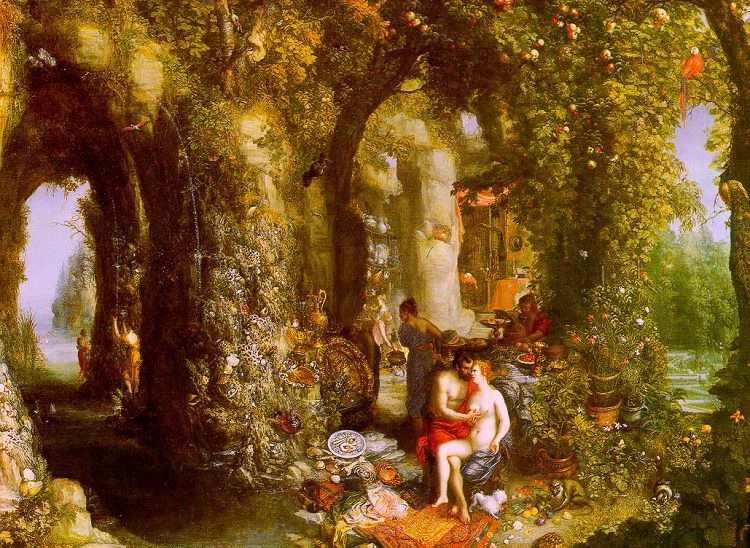
Artists from the Renaissance onward reimagined this episode as a dialogue between the spiritual and the sensual. Jan Brueghel the Elder’s Ulysses and Calypso (1616) and later Angelica Kauffman’s Calypso Calling Heaven to Witness the Fidelity of Ulysses (1779), seen above, reveal a subtle shift — from enchantress to abandoned woman. While the femme fatale is usually blamed for seduction, Kauffman paints Calypso as the wounded lover, humanising her longing rather than vilifying it.
The Romantic Era: The Lure of the Exotic

By the 19th/20th century, artists steeped in Romanticism and Orientalism reinterpreted Calypso through the lens of fantasy and sensuality. Painters like James Draper (above) and George Hitchcock infused her story with lush color and atmosphere, turning Ogygia into an Eden of temptation.
Draper imagined Calypso reflects the Victorian fixation on the dangerous beauty — the woman whose love disrupts the masculine pursuit of reason, progress, and heroism. Calypso thus joins the ranks of other mythic femme fatales — Circe, Salome, Delilah, and Lilith — who were framed not as independent figures, but as obstacles to male destiny. Her allure becomes a kind of sin, her love a trap, her island a gilded cage.
The Modern Reclamation: Solitude, Power, and the Female Gaze
In contemporary art and literature, however, Calypso’s image has been reclaimed as one of female autonomy. Artists and feminist writers reinterpret her not as the captor but as the abandoned goddess, a woman punished for loving too deeply.
In Mary Zimmerman’s 1992 adaptation of The Odyssey and in modern visual art, Calypso’s island becomes a site of introspection — a space where female desire and grief are allowed to exist without moral condemnation.
In this light, the “femme fatale” label dissolves into empathy. Calypso’s so-called fatality lies not in malice, but in the threat she poses to patriarchal narratives of control: she represents the woman who is self-sufficient, who loves on her own terms, and who refuses to fade quietly when the hero sails away.
The Enchantress Remembered
Throughout art history, depictions of Calypso reflect the shifting tides of how we see women who love powerfully. From temptress to tragic lover, from goddess to feminist icon, Calypso endures as a mirror for cultural anxieties about female agency. She is the gentle femme fatale — her danger not in destruction, but in her invitation to stay, to forget, to choose passion over duty. And perhaps that, in itself, is the most radical seduction of all.

Salome: The Dangerous Dance of Desire in Art History
Among all the women cast as femme fatales in Western art, few have burned as brightly — or as scandalously — as Salome. Her story, drawn from the New Testament, tells of a young woman whose dance leads to the beheading of John the Baptist. Over the centuries, artists have turned her image into an enduring symbol of erotic power, moral danger, and the fatal allure of feminine beauty. Yet beneath the layers of jewelled veils and biblical drama lies a deeper truth: Salome’s story reveals more about society’s fear of female desire than about her supposed sin.
The Biblical Origins: The Woman Who Danced for a Head

In the Gospel of Mark, Salome is not even named — she is merely “the daughter of Herodias,” who dances before King Herod and, at her mother’s request, asks for the head of John the Baptist on a platter. Early Christian art focused on the gruesome aftermath: the saint’s martyrdom, not the woman’s role. But by the Renaissance, painters began to shift the gaze. Salome became the subject herself — a figure of fascination, decadence, and forbidden beauty.
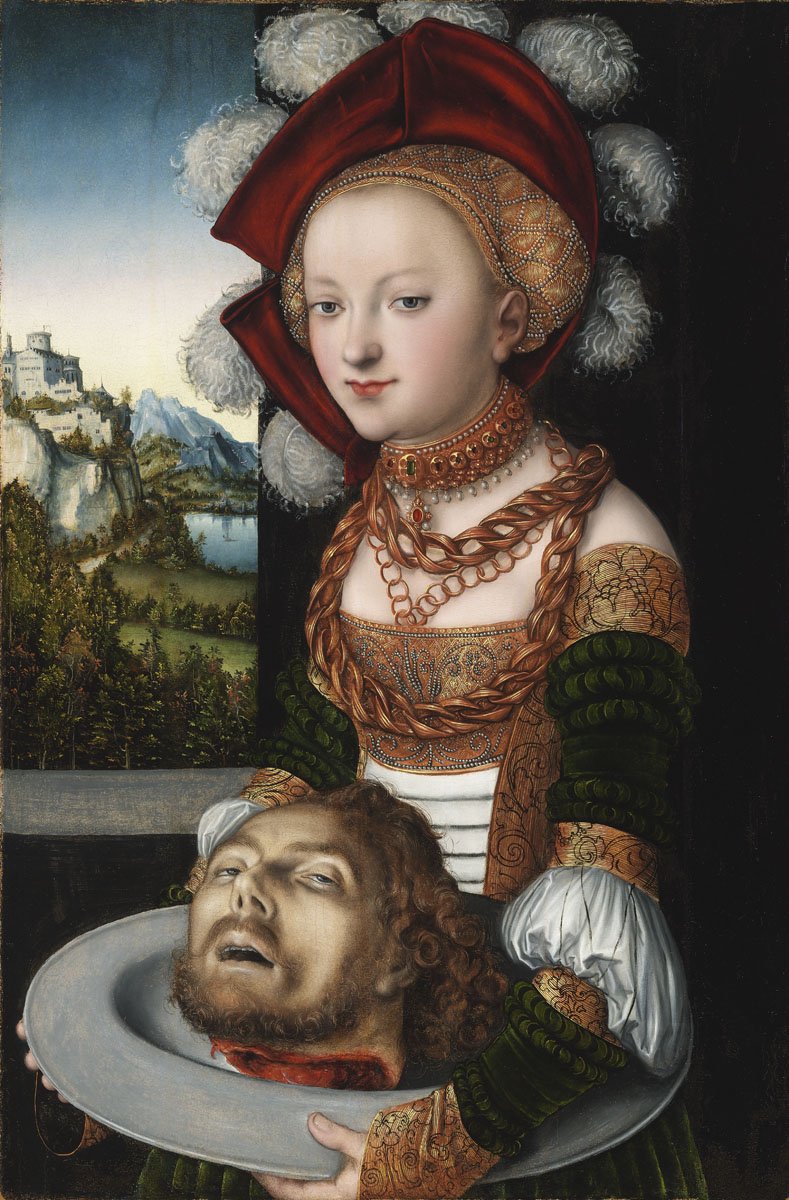
Artists like Titian, seen above, and Lucas Cranach the Elder rendered Salome with an unsettling calm, holding the prophet’s severed head as if it were a trophy or mirror. The juxtaposition of her youth and the brutal act amplified the moral tension: beauty as corruption, desire as death.
The 19th Century Obsession: Decadence and the Femme Fatale

It was in the 19th century, however, that Salome fully bloomed into the archetypal femme fatale. The age of Decadence and Symbolism — fascinated by sin, sensuality, and spiritual collapse — found in her the perfect muse.

Gustave Moreau’s Salome Dancing before Herod (1876), above, transformed her into an ethereal, jewelled enchantress surrounded by gold and symbolism. In Moreau’s vision, Salome is no longer a mere pawn of her mother’s will; she is divine, autonomous, and terrifyingly beautiful. Her dance becomes an act of sacred destruction — an aesthetic experience as much as a moral one.

Following Moreau, artists like Aubrey Beardsley (in his illustrations for Oscar Wilde’s 1894 play Salome) above, and Franz von Stuck, below, pushed her image further into erotic territory. Beardsley’s black-and-white prints distilled her into a creature of pure style: angular, otherworldly, and dripping with sensual menace. Wilde himself wrote of her as a woman who desired “the kiss of a dead mouth,” embodying the Decadent fascination with beauty’s link to death.

The Male Gaze and the Fear of Desire
Salome’s rise as the femme fatale par excellence reveals the unease of a patriarchal culture confronting female sexuality. In these works, her erotic power is both celebrated and punished. Her dance — a performance of freedom and bodily agency — becomes the instrument of her condemnation. The male gaze turns her into spectacle: at once adored and destroyed, desired and feared.
In this sense, Salome’s art-historical journey parallels that of Eve, Lilith, and Medusa. Each represents the same cultural anxiety — that a woman’s independence, or her control over her own body, threatens divine and social order.
Modern Reclamation: The Woman Behind the Veil

In the 20th and 21st centuries, artists have begun to reclaim Salome’s story. No longer a cautionary tale, she becomes a complex woman of agency and defiance, already hints at this shift — the femme fatale not as sinner, but as sovereign of her own desire. Contemporary artists reinterpret Salome as a metaphor for the performance of femininity itself — a woman forced to dance under the weight of male expectation, yet finding liberation in her own spectacle. Her “fatality” is not moral corruption, but the refusal to be passive.
Across centuries, Salome has danced through art history as both muse and monster, saint and sinner. Her evolution mirrors changing attitudes toward women’s power, sexuality, and visibility. Once condemned for her allure, she now stands as a figure of resistance — a woman who dared to move, to look, to command attention.
In the end, Salome’s true crime was not her dance, but her defiance. And perhaps that is why she continues to fascinate: because every age finds in her the image of its own fears — and its own secret desires.
Conclusion: Unlearning the Myth to See the Woman
As we move through the stories of Medusa, Lilith, Calypso, and Salome, one truth becomes unmistakable: the femme fatale we think we know is often a fiction crafted by centuries of fear, misunderstanding, and patriarchal storytelling. The real women—or the real myths—beneath these images are far more complex, and rediscovering their original narratives adds an essential new layer to how we see them.
Peeling back the inherited versions of their stories invites us to unlearn the warnings, distortions, and moral lessons imposed on them over time. It asks us to question why these women were recast as dangerous, seductive, or destructive—and who benefited from that transformation. By refusing to simply copy and paste the stories handed down to us, we reclaim a more truthful and empowered understanding of their roles in mythology and art.
In re-examining these figures, we don’t just correct history—we challenge the broader cultural habit of flattening powerful women into tropes. As we dive deeper into each archetype in the upcoming posts, may we continue to dismantle the old scripts and make space for fuller, more honest interpretations of these enduring women of myth and art.
Thank you for sticking with me through this post. These women's stories are powerful, layered, and so deserving of the attention you've given them. I hope their stories left you feeling informed, energised, and maybe even a little changed. If you've enjoyed this deep dive, feel free to share your thoughts, your favourite moments, or even your own recommendations for women who deserve a spotlight next. Your engagement helps keep these stories alive and seen. And, please share this post with the powerful women in your own life. Until next time, thank you for reading and celebrating these remarkable voices with me.


Comments
Post a Comment